

Table of Contents
Round Shaft vs Square Shaft Helical Piles: Choosing the Right Foundation Support
Choosing the right helical pile shaft is one of the most critical decisions for ensuring long-term structural integrity and project success. When considering round shaft vs square shaft helical piles, performance under load and compatibility with site conditions can vary significantly. Both shaft types are key components of advanced earth anchoring systems, and our selection includes a helical pier lead section designed to accommodate rigorous engineering demands. Factors such as soil profile, load requirements, and installation methodology all influence the optimal choice. With ICC and ISO Certified products and access to our network of structural engineers, you gain Engineering Excellence and Design Support from the start. In the sections below, we break down each shaft type’s performance characteristics to help you decide.
1. Enhanced Torsional Strength of Round Shafts
When assessing round shaft vs square shaft helical piles, the round shaft’s torsional performance is a decisive engineering advantage. The circular cross-section provides an axisymmetric geometry that distributes shear stress evenly around the perimeter under torque, resulting in a higher torsional capacity per unit area. According to geotechnical principles from the International Society for Soil Mechanics and Geotechnical Engineering (ISSMGE), uniform stress distribution in deep foundation elements significantly improves load-bearing predictability and reduces premature yielding.
Square shafts, by contrast, concentrate stress at their corners under torsional loading. Those localized stress risers can initiate material distress earlier, limiting the shaft’s reliable torque range in demanding installations such as dense till, weathered rock, or high-torque embedment applications. Additionally, the consistent material properties achievable with round shaft manufacturing processes support repeatable torsional performance across production runs.
For foundation repair contractors and civil contractors specifying deep foundations, round shaft helical piles deliver the predictability needed in critical high-torque settings. We integrate these round shaft profiles into our foundation repair solutions precisely because the enhanced torsional strength translates into more reliable pile advancement and load transfer during installation.
2. Bearing Capacity Across Soil Conditions
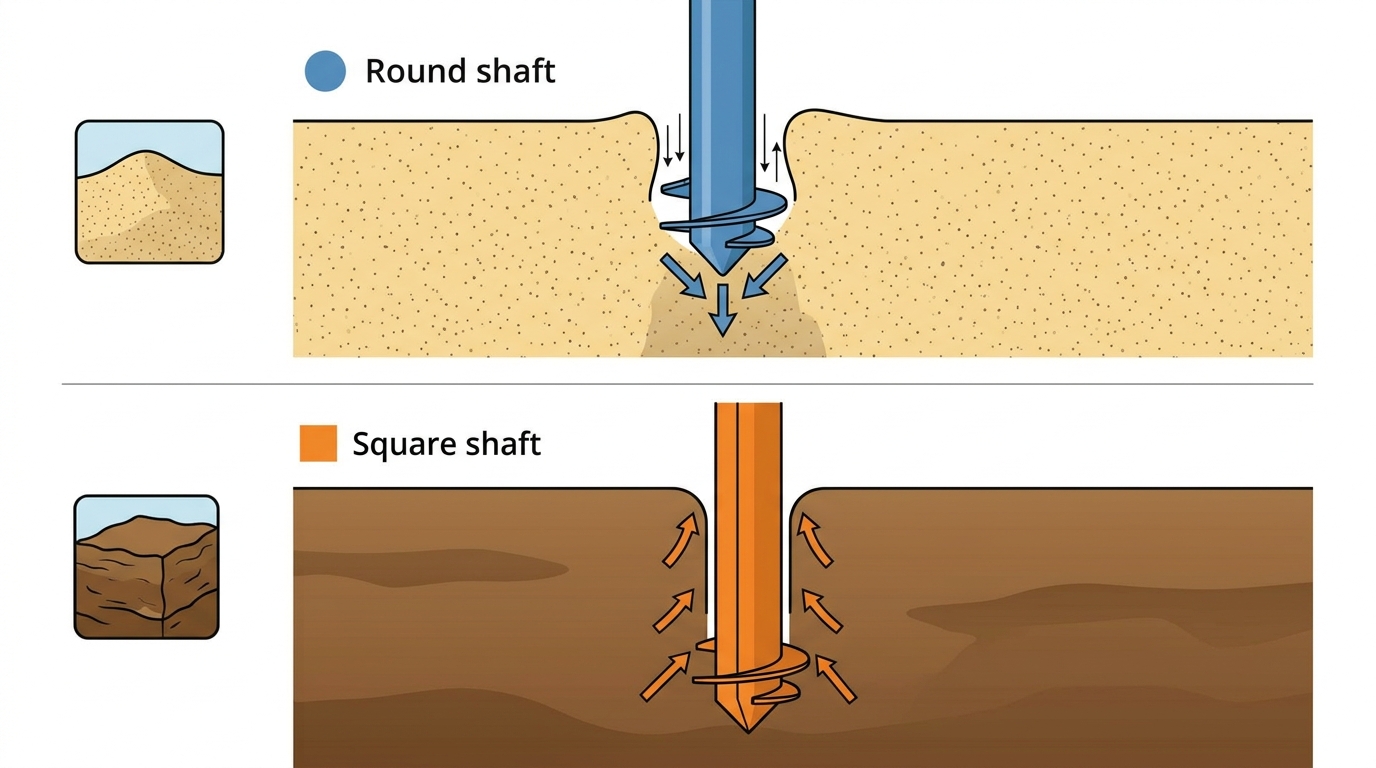
Because soil conditions vary widely, bearing capacity depends heavily on the type and depth of the strata encountered. The choice between round shaft vs square shaft helical piles in loose sands versus in clay soils generally comes down to installation disturbance and surface friction.
In sandy or granular soils, round shaft helical piles often achieve higher bearing capacity because their slender profile displaces less material during installation, preserving dense compaction. In cohesive soils like clay, square shaft piles typically provide greater surface area and superior torque transfer, allowing them to develop capacity more efficiently. We always base final selection on site-specific soil testing and a thorough engineering analysis governed by ICC-ES acceptance criteria AC358 for torque correlation methods.
When the upper strata are too weak to support design loads, our 1.5 inch helical pile extension provides a straightforward way to reach deeper competent bearing layers in 42-inch increments.
These capacity estimates are general; actual performance varies with site conditions. Consult a structural engineer or Helical Technology’s engineering team for project-specific design guidance. Selecting the right pile shaft and extension is only the first step—next we review installation torque correlations that confirm capacity in the field.
3. When Round Shaft Helical Piles Excel
While square shaft helical piles are effective in many residential and light-commercial applications, round shaft designs excel in more demanding scenarios. For contractors and engineers working on high-load commercial projects, the decision between round shaft vs square shaft helical piles often comes down to structural integrity at depth. Round shaft helical piles deliver superior torsional strength in dense or cohesive soils, significantly reducing the risk of shaft twisting during installation.
For deep foundations, the continuous round shaft design minimizes soil friction during driving, improving installation efficiency compared to square shaft alternatives. This advantage is critical when reaching stable load-bearing strata, and our 84 inch helical pile extension is engineered precisely for this purpose. This component, part of our line of ICC and ISO Certified products, provides the necessary reach and structural integrity under high torque loads for commercial buildings and retaining walls.
Round shaft piles also offer greater resistance to lateral and uplift loads due to their uniform cross-section, making them suitable for marine or slope-stabilization projects. Our network of structural engineers provides Engineering Excellence and Design Support to help when choosing between round and square shafts for these complex applications. These performance advantages make round shaft helical piles the preferred choice for deep commercial foundations, as reflected in the following section on installation torque requirements.
4. When Square Shaft Helical Piles Excel
For projects requiring higher capacity and greater torsional strength, square shaft helical piles excel. While round shaft designs serve as the default for many residential and light commercial jobs, the round shaft vs square shaft helical piles distinction becomes critical when deep, high-capacity commercial foundations demand axial loads exceeding 100 kips. We recommend square shaft helical piles in these heavy commercial and industrial scenarios because the square shaft leads provide superior torsional strength compared to round shaft leads of equivalent steel weight, preventing shaft twist during installation in dense soils or when encountering shallow obstructions. According to the Foundation Repair Association, selection criteria that consider load demands and soil challenges help engineers identify where square shaft designs offer distinct performance advantages over round shaft alternatives.
Square shaft advantages over round shafts also include simplified field modification. The square shaft geometry allows for easier welding of extensions when project conditions require non-standard lengths on site, and bolted or pinned connections support rapid installation in tight-access urban or interior retrofit projects where welding is impractical. When to choose square shaft piles ultimately depends on whether the design calls for large-diameter helices and high ultimate capacities. In infrastructure and heavy commercial applications, square shaft helical systems remain the preferred choice for meeting demanding structural requirements with cost-effective, high-capacity performance. Helical Technology supplies both square and round shaft systems, allowing our network of structural engineers to provide impartial, project-specific guidance.
5. Installation Efficiency and Equipment Fit
The comparison of round shaft vs square shaft helical piles is as much about on-site productivity as it is about structural performance. For commercial projects where mobilizing heavy equipment can be time-consuming, choosing the right shaft profile directly affects labor hours, crew efficiency, and overall project scheduling. Understanding how geometry influences torque demand and equipment compatibility allows contractors to plan installations that are both fast and technically precise.
Our round-shaft helical piles are typically installed with smaller, lower-torque hydraulic drives. These compact drive heads can be mounted on skid-steers or mini-excavators, which speeds mobilization and allows installation in areas where larger rigs cannot operate effectively. The lower torque requirement also reduces stress on both the equipment and the pile, contributing to smooth, uninterrupted production cycles.
Square-shaft piles, by contrast, require higher installation torque and more robust equipment—often larger excavators or dedicated torque machines. While this can be a factor when equipment access or ground-bearing capacity is limited, the square profile offers advantages in certain soil conditions where higher torque helps achieve the necessary capacity. The installation guidelines and torque recommendations published by the ADSC IAFD foundation drilling association serve as the industry benchmark for matching equipment to helical pile shaft type.
Neither shaft type is universally superior. The appropriate selection depends on geotechnical parameters, load demands, and available equipment on the project site. Our ICC-ES-certified product line includes both round and square shaft configurations, giving contractors the flexibility to match the pile to the soil conditions without sacrificing installation speed or quality.
We support this selection process with project-specific torque-to-capacity correlations and equipment specifications delivered by our engineering team. This technical guidance enables installers to match equipment to pile size accurately and avoid field delays caused by mismatched tooling. Our broad catalog of helical pipes and lead sections further supports rapid on-site adjustments; if unexpected soil conditions are encountered, crews can add extensions or switch shaft types without halting production. Building on this integration of engineering and logistics, the next section examines how efficient installation translates into measurable cost and lifecycle advantages for commercial foundations.
Consult a structural engineer or the manufacturer’s engineering team for project-specific design and installation guidance.
6. Corrosion Resistance and Longevity
Beyond immediate load capacity, corrosion resistance determines the effective service life of a helical pile foundation. When evaluating for round shaft vs square shaft helical piles, the continuous round profile delivers a critical advantage: it eliminates exposed weld seams along the shaft entirely. For square-shaft piles, connection blocks and plate stiffeners require intermittent weld beads that disrupt any protective coating and create crevices where moisture can collect, accelerating galvanic corrosion in aggressive soils. Our RCS extensions, by contrast, are formed from a single continuous section with a 0.300-inch wall thickness—equivalent to schedule 80 pipe—and hot-dip galvanized to ASTM A123 standards, producing a uniform zinc coating that resists corrosion across the entire surface without a single seam or joint to compromise protection. This sealed, continuous profile also prevents internal moisture ingress, a failure mode that solid-bar or open-channel square-shaft systems cannot address. For the round shaft vs square shaft helical piles comparison in permanent foundations, especially in acidic soils, coastal zones, or industrial sites where corrosion governs design life, the round-shaft design’s clean geometry simplifies specifying increased galvanizing or supplemental coatings. Square-shaft modifications, by contrast, require masking or treating each welded connection, adding complexity and cost. These corrosion-resistance principles are consistent with guidelines from the ISSMGE geotechnical engineering society. This durability advantage is paired with material efficiency, as discussed in the next section on cost-effectiveness.
Consult a structural engineer or the manufacturer’s engineering team for project-specific corrosion assessment and design guidance.
7. Cost Considerations and Budget Planning
Once the structural requirements are understood, cost considerations become the next critical step in selecting the right helical pile system. When comparing round shaft vs square shaft helical piles for commercial projects, budget planners must consider several cost drivers that influence the total foundation investment.
Material costs vary with shaft shape, as square shaft helical piles typically require more steel per linear foot than round shaft alternatives, affecting raw material expense. Installation time differences arise from the torque resistance characteristics of each profile — round shaft piles often install faster in dense soils, potentially reducing equipment hours. Code compliance adds expense when ICC building code requirements mandate specific shaft dimensions or load capacities for a project, a factor confirmed by the International Code Council (ICC) as the authoritative source for model code standards. Soil conditions directly determine the number of piles and shaft length needed, with deeper bearing strata requiring extended sections that increase material and installation costs.
Helical Technology does not publish generic price lists for our advanced earth anchoring systems. Instead, our network of structural engineers uses real-time design software to produce accurate, project-specific pile configurations, enabling custom quotes based on your precise specifications. Commercially insured installations or those requiring jurisdictional approval under ICC-ES acceptance criteria (AC358) may also need stamped engineering documentation, which should be factored into budget planning.
To receive a project-specific budget estimate, submit your specifications to our engineering team. Consult a structural engineer or the manufacturer’s engineering team for project-specific design and installation guidance. Products are certified to ICC/ISO where indicated — installations must comply with applicable building codes and ICC-ES acceptance criteria (AC358).
8. Residential vs Commercial Project Suitability
The choice between residential and commercial helical pile systems depends on structural load demands, shaft configuration, and code requirements. Understanding the differences between round shaft vs square shaft helical piles is essential for selecting the appropriate advanced earth anchoring systems for each project type.
Residential applications typically involve lower structural loads from decks, home additions, and foundation repairs. Square shaft helical piles are common in residential construction for their ease of handling and moderate load capacities. Our 1-1/2″ RCS extensions, as shown in Helical Technology product specifications, provide dependable anchoring for standard residential depths. These round shaft systems also perform well in lighter-duty applications where torque requirements remain modest.
Commercial projects demand higher load capacities, deeper embedment, and faster installation cycles. Round shaft helical piles are often preferred for high-torque, deep commercial installations where multi-helix lead sections and extension lengths reaching up to 60 feet become necessary. ICC-ES certification, such as AC358 compliance, is critical for commercial code approval but also benefits high-end residential jobs requiring engineer-stamped designs. Our catalog includes both standard and custom RCS extensions and lead sections suitable for new construction and retrofits across both project types.
We provide project-specific engineering support through our network of structural engineers for both residential helical piers and commercial helical piers. Ultimately, successful helical pile selection requires matching shaft type, diameter, and embedment depth to site conditions, and all designs should be reviewed by a qualified structural engineer or Helical Technology’s engineering team.
Your Next Step: Selecting the Right Shaft for Your Project
Now that you understand the technical differences, the round shaft vs square shaft helical piles decision comes down to your project’s depth, torque, and load demands. Round shaft configurations typically excel in deeper, high-torque commercial applications, while square shaft options often satisfy lighter residential loads and shallower soil conditions. Our ICC and ISO Certified products include both shaft types, each backed by ICC-ES documentation, giving you reliable advanced earth anchoring systems for any scope of work.
When you’re ready to move forward, our network of structural engineers provides Engineering Excellence and Design Support, using in-house design software to match the right shaft to your geotechnical report and load specifications. We also offer installer training that reinforces proper torque monitoring and helical plate selection. Request a custom quote through our website or contact our team directly to begin your project-specific evaluation. Consult a structural engineer or the manufacturer’s engineering team for project-specific design and installation guidance.
Resources
- Get ICC-Certified 1-3/4-Inch Helical Lead Section
- Find 42-Inch 1.5-Inch RCS Helical Extension
- Get 84-Inch 1.5-Inch Helical Pile Extension
- Find Standard-Depth 60-Inch Helical Extension
- Get Robust 84-Inch 1.75-Inch Helical Pier Extension
- Get Precise 42-Inch 1.75-Inch Helical Extension
- Get 1.5-Inch Helical Extension with Integrated Helix
- Find Certified Foundation Repair Professionals via NFRA
- Discover ADSC-IAFD Resources for Foundation Drilling Professionals
- Use ICC Digital Codes to Streamline Building Compliance
- Explore ISSMGE Geotechnical Engineering Resources and Publications