

Table of Contents
- Understanding Foundation Underpinning Costs for Contractors
- Key Factors That Influence Foundation Underpinning Costs
- Helical Piles Versus Traditional Concrete Piering: A Cost Comparison
- How Site Conditions and Property Type Affect Underpinning Costs
- The Value of Engineering and Design Support in Underpinning Projects
- Training and Certification for Cost-Effective Helical Pier Installation
- Delivering Cost-Efficient Foundation Solutions with Helical Technology
Understanding Foundation Underpinning Costs for Contractors
When planning a repair project, understanding the foundation underpinning cost is essential for accurate budgeting. The helical pier installation cost depends on several cost factors that vary by site. Key variables include:
- Soil conditions and groundwater levels
- Pier depth, diameter, and load requirements
- Site accessibility and equipment constraints
- Engineering design and permitting fees
No fixed price per foot exists because each underpinning project is unique. We provide real-time design software and a network of structural engineers to help you model your underpinning costs for contractors before you submit a quote. Our ICC-ES certified helical piers, backed by advanced earth anchoring systems and Engineering Excellence and Design Support, ensure code compliance and reduce liability. Contact our team for a custom estimate today. Project-specific costs depend on engineering requirements; consult our team for accurate estimates.
Key Factors That Influence Foundation Underpinning Costs
After reviewing common foundation repair methods, several key factors influence foundation underpinning cost. Because every site is different, consulting a structural engineer or Helical Technology’s engineering team is essential for project-specific design and installation guidance. All our products are ICC- and ISO-certified, and installations must comply with local building codes and ICC-ES AC358 criteria.
The following factors drive the cost of underpinning:
- Soil conditions: The soil’s bearing capacity and moisture content directly affect pier type and depth.
- Required pier depth: Deeper installations into competent load-bearing strata increase material and labor.
- Site accessibility: Limited access, tight crawl spaces or interior installations can require specialized equipment and add labor hours.
- Structural load: The building’s weight and design determine the pier count, pipe size and strength needed.
- Engineering and permit fees: Geotechnical reports, structural design work and local permits contribute to underpinning project costs.
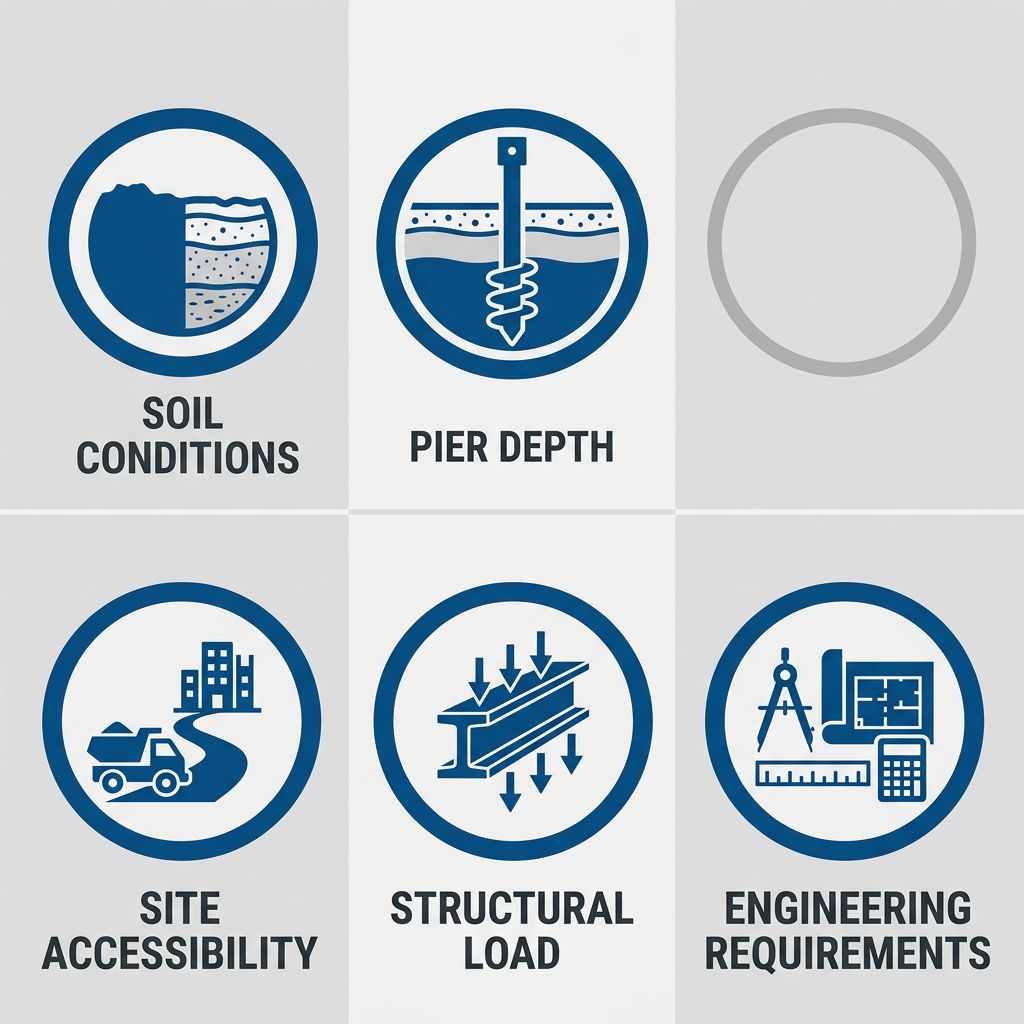
Five key cost factors for foundation underpinning illustrated by Helical Technology.
No single price applies to all projects because these variables interact uniquely per site. The installation environment—exterior grade versus basement or crawl space—further influences labor and equipment selection. This is why the cost of foundation underpinning requires a thorough on-site evaluation.
Comparing Helical Pier and Concrete Underpinning Methods
For many applications, helical piers prove more cost-effective than concrete underpinning. To understand helical pier installation cost vs. concrete, our detailed comparison shows helical piers require less excavation, produce no concrete curing delays and work well in limited-access areas. This reduces overall project duration and restoration work, which often translates into savings for the property owner.
Contractors estimate helical pier projects by evaluating geotechnical data, running load calculations through our real-time design software and factoring in mobilization and labor. Our engineering support and manufacturer-provided design tools help installers deliver accurate, site-specific estimates rather than generic quotes.
Final costs are determined by the certified installer and structural engineer after an on-site assessment. In the next section, we cover the helical pier installation process and how our network of certified installers ensures efficient, code-compliant repairs.
Helical Piles Versus Traditional Concrete Piering: A Cost Comparison
When evaluating a foundation underpinning cost, it is essential to move beyond initial price tags and understand the distinct cost drivers of helical piles versus traditional concrete piering. We aim to provide a transparent breakdown so you can make an informed decision for your project. The initial investment in materials and labor for our helical pile cost reflects advanced engineering and high-strength steel, whereas a concrete pier cost is primarily dictated by extensive excavation, concrete volume, and lengthy curing times.
Our helical pier installation cost is influenced by several factors that differ significantly from poured concrete methods. While the steel components of a helical system carry a higher upfront material cost, the installation is markedly faster. A hydraulic drive head installs them in minutes, requiring minimal equipment and no spoil removal. In contrast, concrete piering demands heavy machinery for digging deep holes, setting forms, pouring tons of concrete, and then waiting days or weeks for it to cure, which drives up labor and site management expenses substantially.
Beyond these obvious line items, hidden fees can distract from the true comparison. According to Helical Technology, a detailed, line-by-line custom quote is the best defense against budget surprises. Variable costs for concrete piering might include concrete pump truck fees and off-hauling large volumes of excavated soil. For helical systems, potential additional expenditures often stem from professional engineering reports and local municipal permit fees. Site-specific conditions, such as buried concrete debris or extremely limited access like cramped crawl spaces, are also significant variables that can increase the helical pier installation cost on paper, though these challenges are usually easier to manage than the massive excavation required for traditional methods.
While the initial outlay for a helical system may be higher, the long-term value proposition is compelling. The rapid installation and immediate load-bearing capacity allow construction to proceed without delay, significantly reducing overall project timelines. Furthermore, the small installation footprint drastically reduces restoration costs for landscaping, decks, and hardscaping—expenses that often balloon after the heavy equipment work of a concrete pour. This immediate usability and minimized disruption frequently make helical piles the more economical solution over the life of the project.
Obtaining a custom, manufacturer-backed quote is critical for an accurate comparison. We provide our certified installer network with real-time design software for precise modeling, ensuring every variable is accounted for professionally. Consult a structural engineer or the manufacturer’s engineering team for project-specific design and installation guidance. Our network of structural engineers and our ICC and ISO Certified products stand behind every quote, delivering a foundation repair solution that balances upfront costs with long-term structural integrity.
How Site Conditions and Property Type Affect Underpinning Costs
Understanding foundation underpinning cost variables begins with recognizing that no two sites are alike. The helical pier methods introduced in the previous section offer exceptional versatility, but their precise application — and final expense — depends heavily on what lies beneath and above the ground. We see wide variation across projects because the cost to underpin a foundation is driven by geological realities, structural demands, and logistical constraints that only reveal themselves during careful site evaluation.
Soil type is often the single most influential factor. Dense, load-bearing strata such as glacial till or bedrock require powerful drilling equipment and specialized tooling, which increases both labor hours and equipment wear. In contrast, loose sand or organic-laden soils may demand deeper pier installations to reach stable bearing capacity, adding material and installation time. Expansive clay presents a unique challenge because its cyclical shrink-swell behavior can undermine shallow underpinning solutions; the piers must extend well below the zone of seasonal moisture fluctuation. Our engineering team emphasizes that accurate geotechnical data is essential to right-size the pier depth and diameter for these variable conditions, directly impacting overall underpinning expenses.
Property type further shapes foundation underpinning cost in residential and commercial contexts. A single-story home typically requires less load capacity than a multi-story commercial building or an industrial warehouse, meaning pier shafts with smaller diameters and thinner walls may suffice for residential work. Commercial structures, however, demand higher load requirements for both dead and live loads — including heavy equipment, inventory, and occupant traffic — which often translates to larger, deeper helical piles and more rigorous connection detailing. A three-story office building, for example, needs a far more robust underpinning solution than a one-story residence, and the engineering calculations become proportionally more complex.
Site accessibility introduces another layer of cost variability. Narrow lot lines, mature landscaping, low-clearance crawl spaces, and the presence of underground utilities all restrict the equipment that can be used and the pace of installation. When our installers must excavate by hand or use compact machinery to avoid damaging existing structures, the labor component rises. Basement depth and existing foundation condition also matter — a deteriorated footing may require supplemental concrete repairs or custom bracket configurations before helical piers can be installed effectively. These interlocking variables make it clear why fixed-price catalogs are rarely realistic.
The takeaway is that no two underpinning projects share an identical cost profile. Site geology, building loads, and access constraints combine to create a unique engineering puzzle that demands professional evaluation rather than generic budgeting benchmarks. Our engineering support team helps installers optimize helical pier designs for these specific conditions, potentially reducing material redundancies and streamlining the installation sequence. For homeowners and contractors seeking broader educational resources, the foundation repair association offers independent guidance on industry best practices and standards.
In our next section, we will explore how to move from these influencing factors toward a tailored estimate, including what to expect during a professional on-site assessment and how design-stage decisions can help manage project scope. Consult a structural engineer or our engineering team for project-specific design and installation guidance. Products are certified to ICC/ISO where indicated — installations must comply with applicable building codes and ICC-ES acceptance criteria (AC358).
The Value of Engineering and Design Support in Underpinning Projects
Pairing high-quality underpinning products with robust engineering support is what separates a routine installation from a lasting structural solution. For contractors, this partnership directly affects the foundation underpinning cost by reducing the risk of field errors, rework, and project delays. At Helical Technology, our approach to Engineering Excellence and Design Support is built into every product purchase, ensuring you have access to a network of structural engineers and proprietary design software that transforms complex load calculations into clear, actionable plans.
Our engineering team reviews each project’s soil data, loading requirements, and site constraints to produce stamped drawings that satisfy ICC and local building code requirements. This service exists to remove the guesswork from helical pier and push pier placement. By providing installation specifications tailored to your project, we help control underpinning project costs before any equipment touches the ground. The design phase is where costly mistakes are intercepted, and having manufacturer-backed engineering means you can proceed with confidence, knowing that the proposed pier type, depth, and bracket configuration have been vetted by experienced professionals.
A central piece of this process is our real-time design software, which enables accurate modeling of axial and lateral loads for both residential and commercial applications. This tool gives you immediate feedback on helical pier capacities and push pier performance, allowing you to refine designs while you are still on site with a client. Instead of relying on generic tables, you generate project-specific models that inform precise product selection and layout. This capability not only reduces the time spent on plan revisions but also provides a clear visual reference for crews, minimizing the likelihood of installation errors.
Beyond the technical calculations, our support includes ICC-ES documentation that streamlines the permit-approval process. Many municipalities require documented proof that underpinning products meet specific acceptance criteria, and our ICC-ES reports (conforming to AC358) offer that verification. This documentation—paired with your project’s stamped engineering package—gives building officials the data they need to process applications quickly. For contractors, access to these resources means fewer administrative hurdles and less downtime waiting for approvals, which ultimately protects the overall cost of foundation repair jobs.
Engineering support from a manufacturer with a dedicated structural engineer network does more than satisfy code; it positions your business to take on more complex projects with higher load demands. Whether you are stabilizing a residential foundation or designing a commercial underpinning plan, we provide the technical backing that allows you to bid aggressively without sacrificing quality. Our team is available to serve as your engineering resource, ensuring that every installation is supported by professional design work and accurate specifications.
Consult a structural engineer or the manufacturer’s engineering team for project-specific design and installation guidance—our site explicitly offers structural engineer support. Products are certified to ICC/ISO where indicated; installations must comply with applicable building codes and ICC-ES acceptance criteria (AC358).
In the next section, we will explore the specific product lines—helical piers, push piers, and repair brackets—that benefit from this comprehensive engineering framework, showcasing how each system performs when backed by professional design support.
Training and Certification for Cost-Effective Helical Pier Installation
Controlling foundation underpinning cost begins with precision in the field — minimizing errors, material waste, and callbacks. Our installer training and certification programs are designed to achieve exactly that. By equipping contractors with advanced techniques and project-specific guidance, we help our network deliver cost-effective helical pier installation while maintaining full code compliance.
Certification through Helical Technology’s program validates that an installer meets the rigorous standards of ICC-ES AC358, the acceptance criteria for helical pile systems. The Foundation Repair Association, a national professional body, underscores that standardized training is a cornerstone of quality and ethics in foundation repair. Our certified contractors approach every job with a proven methodology that reduces rework risk — a direct driver of underpinning cost reduction. Fewer installation errors mean less material waste, shorter project timelines, and a stronger bottom line for both the contractor and the property owner.
Training extends well beyond initial certification. Every certified installer gains access to our network of structural engineers, who provide job-specific design and troubleshooting support. This collaboration ensures that even complex soil conditions or unusual structural loads are addressed correctly from the start, further protecting the project budget. Our curriculum also covers the applicable building code requirements and ICC-ES acceptance criteria in detail, so crews leave with a clear understanding of how to stay compliant without unnecessary delays or expensive rework.
All training is customized to the needs of the contractor’s team; we do not publish fixed pricing because every program is scoped individually. To learn more about how certification can lower your foundational project costs, contact Helical Technology. We will assemble a custom training quote that aligns with your crew size, experience level, and project types. In the next section, we explore how our engineering and design support complements the skills of a certified installer, providing the technical backbone for every successful underpinning project, and ensuring consistent, verifiable, long term installation outcomes.
Delivering Cost-Efficient Foundation Solutions with Helical Technology
When assessing foundation underpinning cost, helical technology delivers clear advantages. Our helical piers install in hours, not days—minimal excavation means lower labour and equipment expenses. This cost-effective underpinning approach works for both residential and commercial projects.
We engineer each pier to match the specific project, eliminating over-design and material waste. This tailored design directly reduces your total foundation underpinning cost compared to one-size-fits-all concrete piers. Our ICC/ISO-certified products and manufacturer design support add long-term value by reducing risk and ensuring code compliance.
Compared to concrete piers, helical solutions offer affordable foundation repair without sacrificing strength. Exact costs vary and require a custom quote from an authorized installer, but the inherent speed and reduced site disruption make helical economic foundation repair a wise investment. We recommend consulting a structural engineer for project-specific design; all installations must comply with ICC-ES AC358. Our engineered helical piers deliver these savings with reliable support, as outlined in the next section.
Resources
- Get Custom Helical Pier Installation Quote
- Compare Helical Pier and Concrete Underpinning Costs
- Learn How Contractors Estimate Helical Pier Costs
- Avoid Hidden Costs in Helical Pier Installation
- Learn About Residential Helical Pier Repair Costs
- Explore Factors Affecting Helical Pier Costs
- Hire Porch Builders with Helical Foundation Support
- Discover the National Foundation Repair Association