

Table of Contents
Helical Pier Installation Cost Factors for Contractors
For contractors estimating helical pier installation cost, several variables shape total project expense. According to the foundation repair association, soil conditions are the leading cost driver, governing required pier depth and installation method. Load capacity requirements determine pier size, shaft diameter, and helix configuration, directly influencing material pricing.
Site accessibility presents another significant variable. Tight access, existing structures, and underground utilities add labor hours and equipment complexity. Regional labor rates and local permitting requirements create further market variation across project locations. Our Engineering Excellence and Design Support team provides project-specific parameters that clarify these variables.
Understanding these helical pier cost drivers helps contractors evaluate the most efficient system for each project. Contact our engineering team for a custom quote tailored to your specific helical piers foundation repair requirements.
1. Soil Conditions and Pier Selection
The soil beneath a structure is the single most important variable in helical pier design. Before any pier is selected, we must understand the ground’s composition, because load-bearing capacity and installation depth depend entirely on what lies below the surface. We always begin with a thorough geotechnical survey to classify the site’s subsurface characteristics.
Different ground types present distinct challenges. Cohesive soils like clay offer good lateral support but can shrink and swell with moisture changes, requiring deeper helix placement to reach stable strata. Granular soils such as sand and gravel drain well but provide less friction, often demanding larger-diameter helices or multiple helix plates to achieve the required capacity. Organic or loamy soils near the surface are almost never load-bearing, so piers must extend through these weak layers into competent ground below.
Soil bearing capacity and the local groundwater level dictate the pier’s final configuration — its shaft diameter, the number and size of helices, and the overall depth of installation. Standards published by the geotechnical engineering society define the soil categories that directly affect pier design. Where challenging ground is encountered, our 3-1/2″ helical pipe piles, available in schedule 40 and schedule 80 wall thicknesses, along with diameter extension products, provide the versatility needed to match almost any condition. We work with our network of structural engineers to ensure each pier is specified precisely for the site, turning subsurface complexity into a cost-effective solution rather than a budget surprise.
Proper selection driven by accurate soil data avoids over-engineering and prevents performance issues, ultimately protecting the long-term investment. Consult a structural engineer or our engineering team for project-specific design and installation guidance.
2. Helical Piers vs Push Piers
When evaluating helical pier vs push pier solutions for a foundation project, the distinction lies primarily in their installation methods and structural applications. Both systems are recognized for their reliability and performance, with our products being ICC-approved and ISO-certified to meet rigorous industry standards and recognized by the Deep Foundations Association.
Helical piers, such as our lead sections with helix plates, are hydraulically screwed into the ground, providing excellent tension and lateral resistance—ideal for lighter structures, retrofits, or sites with limited access. In contrast, push piers are driven straight down to refusal on stable soil or bedrock, making them the preferred choice for heavier structural loads and larger commercial projects. Helical Technology supplies both systems as part of our advanced earth anchoring systems, ensuring you have the right solution for the specific soil conditions and load requirements.
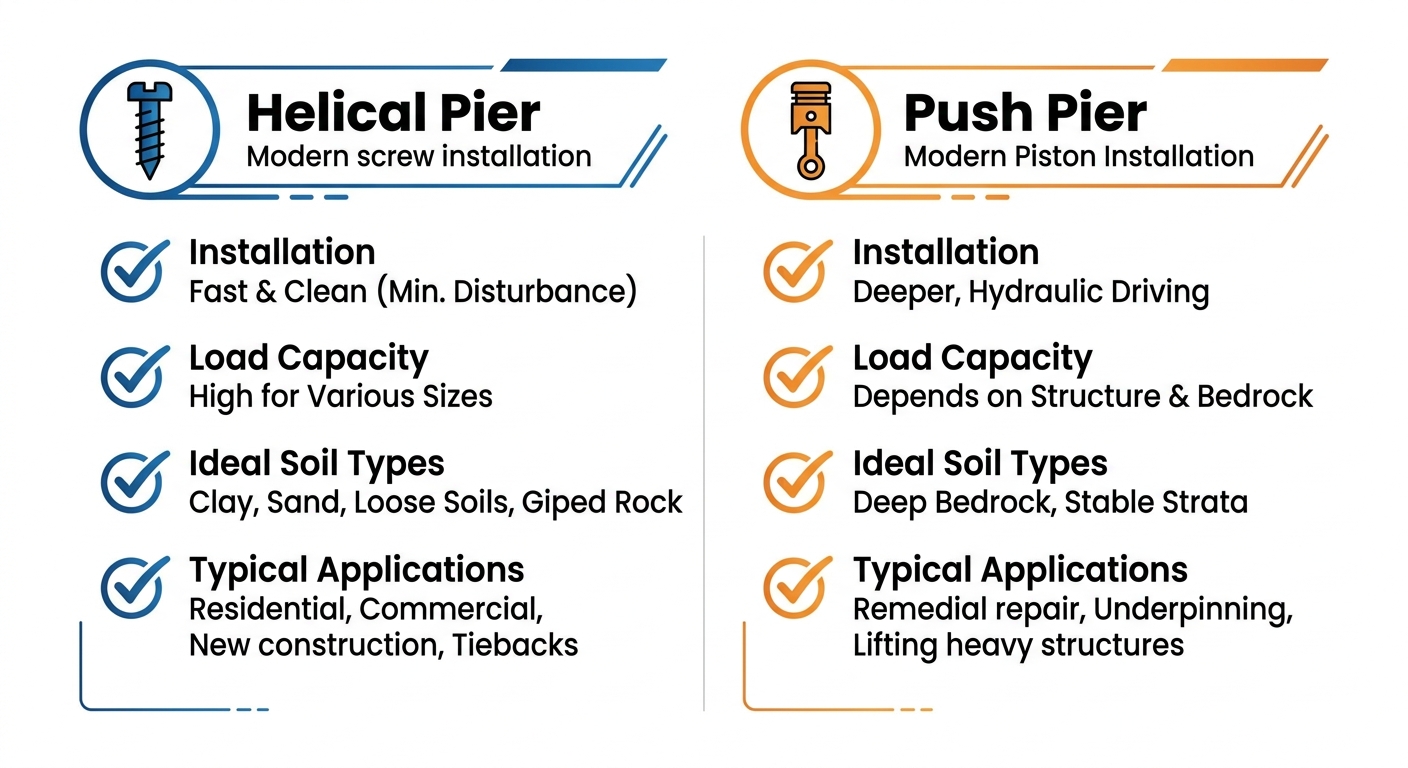 Comparison of helical pier and push pier foundation solutions
When it comes to helical pier installation cost, we take a custom-quote approach because every project has unique variables—soil profiles, structural loads, and access constraints—that affect pricing. While push pier systems may involve more extensive equipment and deeper driving, faster helical installations can often provide time and labor efficiencies for many helical piers foundation repair applications. We encourage you to contact our engineering team to discuss your specific project needs and receive a project-specific cost estimate. Our network of structural engineers provides the engineering excellence and design support you can rely on. Consult a structural engineer or our own engineering team for project-specific design and installation guidance.
3. Foundation Load Requirements
With the components defined, we now examine the structural loads that determine their sizing and configuration. Understanding these load requirements early prevents costly mistakes and ensures that your investment in helical pier installation cost yields a reliable, long-lasting foundation. Every foundation repair or new construction project demands a precise load analysis to safeguard the structure over its entire service life.
Helical piers must resist three fundamental load categories. Axial compression carries the downward weight of the structure, while tension and uplift counteract wind, seismic, and buoyancy forces that try to pull the pier out of the ground. Lateral loads from soil pressure and wind impose horizontal demands that the pier shaft and helix configuration must also accommodate. Structural engineers derive these requirements from site-specific geotechnical soil reports and applicable building codes such as the IBC. For helical piers foundation repair, load demands are often more complex because the existing structure may have already experienced differential settlement or moisture-related soil changes.
Achieving load capacity relies on selecting the correct lead section with the right combination of helix diameter, helix count, and pipe wall thickness. The industry-standard acceptance criteria outlined in ICC-ES AC358 guide this selection, ensuring the installed pier meets both ultimate and allowable capacities. Selecting the correct helical pier lead section is critical to achieving the required axial and tension capacities. Our load-rated lead sections, such as the 2-7/8” diameter schedule 40 and schedule 80 options, are tested to support specified design loads. When evaluating helical pier vs push pier solutions, the load transfer mechanism differs: helical piers use helices to bear on undisturbed soil, while push piers rely on end-bearing and skin friction. The right choice depends on the load profile your engineer identifies. These load requirements directly inform the design and testing procedures covered in the next section.
Consult a structural engineer or our engineering team for project-specific load requirements.
4. Equipment and Installation Complexity
Once the helical pier load capacity has been determined, the physical installation relies on modular components and specialized machinery. When evaluating helical pier installation cost, it is important to understand the equipment required and the factors that influence how efficiently a project can be completed. Our advanced earth anchoring systems are designed with a focus on practical, field-ready engineering that simplifies assembly without compromising structural performance.
We manufacture helical pipes diameter extension helix in standard diameters, including 2.875-inch and 3.5-inch options, with the 124-inch extension being a commonly specified product for deeper installations. Available in both Schedule 40 and Schedule 80 wall thicknesses, these components create a modular assembly where lead sections with welded helix plates are driven first and then extension pipes are added using a bolted or pin connection. This modular approach means a residential helical pier may use only one to three extensions, while a commercial helical pier could require three to six or more depending on the soil report and total design load.
Installation requires a hydraulic drive motor mounted on an excavator or skid-steer, paired with calibrated torque monitoring equipment to verify that each pier achieves the required capacity. Complexity increases when crews encounter buried obstructions such as rock, demolition debris, or existing foundations, or when access is limited in interior crawl spaces. Compared to driven piles or cast-in-place concrete piers, helical pile installation is generally less invasive because there are no excavation spoils and no concrete curing time, keeping projects moving forward faster. Many contractors choose helical piers foundation repair systems specifically because the installation process is cleaner and causes less disruption to surrounding landscapes.
We provide on-site training and installation certifications that reduce the contractor learning curve and ensure best practices for torque monitoring, soil correlation, and safe assembly. The ease of assembly directly affects installation time and long-term performance, which we examine in the next section.
5. Engineering Design and Permitting Fees
Beyond component costs, engineering design and permitting fees represent a separate but necessary investment in any helical pier installation cost analysis. Helical pier installation almost always requires a site-specific engineering design and stamped drawings, which are distinct from the physical installation costs.
Engineering design services for a helical pier project typically range from $500 to $2,500 per pier, depending on the project’s complexity and load requirements. For a typical residential application using a 3-1/2 inch helical pipe extension, engineering design fees will fall at the lower end of the range. More complex commercial projects with high load capacities may require a full geotechnical report, which adds $1,500 to $5,000 to the design phase.
Permit fees, meanwhile, are determined by the local municipality and usually range from $200 to $1,000, depending on the jurisdiction and scope of work in Littleton. We recommend asking your contractor for a clear breakdown of design versus permit fees before signing a contract. Many contractors bundle these costs into a single line item on the proposal for simplicity, and using an ICC-ES certified product can streamline the permitting process because the product already meets key code requirements.
For helical piers foundation repair projects, the engineering demands can be more variable, particularly when existing structural conditions are unknown. Once permits are secured, our attention turns to the next phase: installation labor and equipment costs.
6. Hidden Fees and Accurate Quotes
The true helical pier installation cost becomes clear only when you receive a comprehensive, line-by-line custom quote. Helical Technology provides fully transparent pricing for helical piers foundation repair, detailing every component, service, and engineering support hour up front. We never rely on generic price lists because every project demands unique structural calculations and soil condition analysis.
In our quotes, there are no hidden fees. We reject the common industry practice of burying undisclosed charges for shipping, engineering reports, mobilisation, or permit handling. Whether your project requires a helical pier vs push pier solution, our quotes cover all necessary components—including helical pipes, brackets, and waterproofing materials—with nothing left off the estimate.
Every quote is backed by our network of structural engineers and real-time design software, ensuring precise material takeoffs and labour estimates at no additional cost. Contact our sales team today to request your custom quote and experience engineering support built into every project’s foundation.
Consult a structural engineer or Helical Technology’s engineering team for project-specific design guidance. All installations must comply with applicable building codes and ICC-ES AC358 acceptance criteria.
Getting Accurate Helical Pier Cost Estimates for Your Project
Once you understand how helical piers work, the next logical question is cost. Getting an accurate helical pier installation cost for your specific property is the smartest first step, but the price varies significantly based on soil conditions, pier depth, load requirements, and site accessibility. There is no flat price per foot for helical piers foundation repair.
Instead of relying on generic online calculators, our engineering team provides a free, no-obligation quote that includes a review of your geotechnical report and structural engineer’s design—ensuring the estimate is precise and code-compliant.
This professional approach eliminates guesswork and gives you confidence that your project meets ICC and ISO Certified product standards.
Resources
- Get Certified 3.5-Inch Helical Pipe Piles for Earth Anchoring
- Find Certified 84-Inch Helical Pipe Extension for Foundation Repair
- Discover Certified Helical Pier Lead Section with Helix
- Get 64-Inch Helical Pipe Extension for Foundation Repair
- Find 2.875-Inch Helical Pier Lead Sections for Anchoring
- Get 124-Inch Helical Pipe Extensions for Deep Foundations
- Enroll in Certified Helical Pier Installation Training Program
- Join NFRA for Foundation Repair Industry Resources
- Explore ADSC-IAFD Resources for Deep Foundations
- Access Geotechnical Publications through ISSMGE Library