

Table of Contents
- Geotechnical Soil Report Costs in Denver, Colorado
- Soil Conditions and Geotechnical Report Costs Across the Denver Metro Area
- Soil Testing Services and Foundation Repair Solutions in Denver
- Local Building Codes and Geotechnical Requirements for Foundation Repair
- Steps to Get a Geotechnical Report and Choose the Right Foundation Repair Products
- Making Informed Foundation Repair Decisions with Geotechnical Data
Geotechnical Soil Report Costs in Denver, Colorado
A geotechnical soil report is a professional analysis of subsurface conditions—examining soil type, bearing capacity, and groundwater levels—that engineers require for safe foundation design. The geotechnical soil report cost in Denver typically ranges from $500 to $5,000 for a residential property, though complex commercial projects can exceed $10,000. Several factors drive this pricing: site accessibility, required borehole depth, the number of test pits, and the complexity of laboratory testing all play a role. Denver’s local geology, characterized by expansive clays and loess deposits, often demands more rigorous investigation than stable-soil regions. While USGS geological survey data provides valuable regional context, it can never substitute for a site-specific report. Industry benchmarks from the Foundation Repair Association confirm that investing in accurate soil data prevents costly foundation failures and guides the selection of appropriate solutions, including helical piers. At Helical Technology, our engineering team relies on these reports to recommend the right foundation repair strategy for every project in the Denver area.
Soil Conditions and Geotechnical Report Costs Across the Denver Metro Area
In the Denver Metro area, the geotechnical soil report cost varies significantly depending on underlying soil conditions. Expansive clay soils, which are prevalent in the region, often require deeper borings and more extensive lab testing, driving up the cost of geotechnical soil reports compared to sites with stable sand or loam. Understanding these local soil characteristics is essential for accurate foundation repair design.
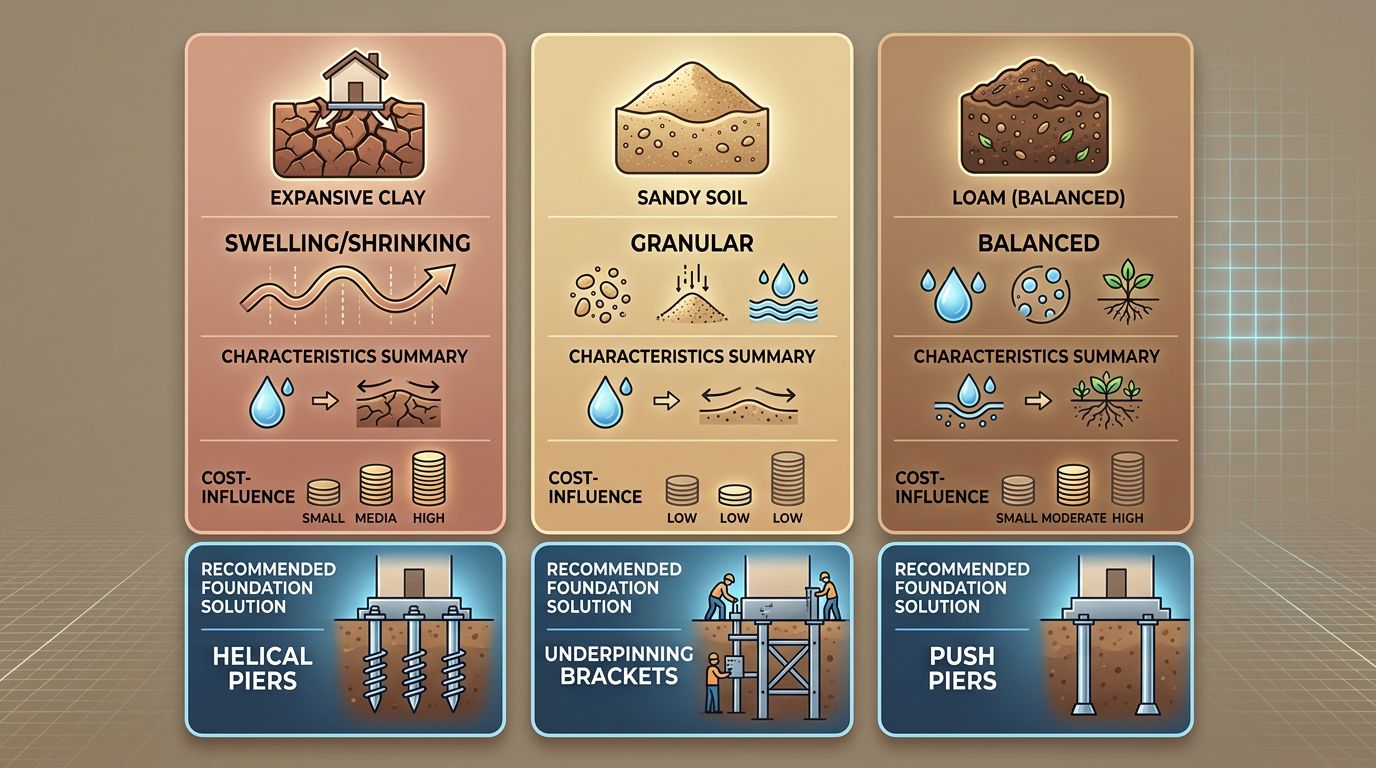
Denver soil types and foundation repair solutions comparison
As illustrated in the comparison infographic, the three primary soil types—clay, sand, and loam—each present distinct challenges for foundation stability. Clay’s high plasticity demands careful load analysis, sand may require compaction verification, and loam offers moderate predictability. These differences directly influence testing scope and recommended repair systems, as detailed in the table below:
| Soil Type | Characteristics | Test Cost Influence | Recommended Solutions |
|---|---|---|---|
| Expansive, high plasticity; common in Denver area | Swelling/shrinking with moisture; requires deeper sampling | Moderate to high; needs more borings and lab tests | Helical piers or push piers to reach stable load-bearing strata |
| Granular, well-draining; variable density | Loose sand may require compaction testing | Lower cost; fewer borings needed if consistent | Helical piers with appropriate torque calibration |
| Balanced mixture; good load-bearing if stable | Uniform fill; moderate plasticity | Moderate; standard testing protocol | Underpinning brackets or helical plates depending on load |
We strongly recommend a thorough geotechnical investigation to avoid common foundation pile failure causes, as detailed in our technical FAQ. Given these soil conditions, it’s essential to choose the right certified solution. Consult a structural engineer or our engineering team for project-specific design and installation guidance. Our products are ICC- and ISO-certified; installations must comply with applicable building codes and ICC-ES acceptance criteria (AC358).
Soil Testing Services and Foundation Repair Solutions in Denver
Understanding the soil beneath your property is the first critical step in any effective foundation repair project. The cost of a geotechnical soil report is a worthwhile investment that identifies critical factors like expansive clay, loose fill, or insufficient bearing capacity common to Denver soil conditions. With this data, we can recommend the most reliable foundation repair solutions tailored to your specific site challenges.
Denver’s unique geology often requires specialized deep foundation systems to ensure long-term stability. Helical Technology provides a comprehensive range of foundation repair solutions, including helical piers, push piers, and underpinning brackets, all engineered to address these local soil challenges. Industry standards for these installations are championed by the ADSC IAFD deep foundations association, which promotes best practices for drilled shaft and anchored earth retention technologies. Their guidelines ensure that every helical pier and underpinning system is installed to the highest safety and quality benchmarks.
Our commitment to project success extends well beyond supplying products. We offer robust engineering design support and a network of structural engineers to ensure precise, code-compliant installations. Every product in our catalog is backed by ICC and ISO Certified quality, reflecting our dedication to engineering excellence and design support. While the investment in a geotechnical soil report guides the initial diagnosis, obtaining a custom quote from our team is the next step toward a permanent fix. Contact us to discuss your project requirements and receive a tailored solution. Consult a structural engineer or Helical Technology’s engineering team for project-specific design and installation guidance.
Local Building Codes and Geotechnical Requirements for Foundation Repair
Any foundation repair method must adhere to local building codes that incorporate model codes like the International Building Code (IBC) and International Residential Code (IRC) published by the International Code Council (ICC). These codes set minimum standards for load-bearing capacity, installation depth, and corrosion protection. Additionally, ICC-ES acceptance criteria (AC358) govern the evaluation of helical pier systems used in foundation repair.
Before designing a repair, a geotechnical soil report is typically required to determine soil bearing capacity, groundwater conditions, and settlement potential. Proper interpretation of the report by a structural engineer minimizes the risk of costly compliance failures and ensures the repair design meets site-specific demands and local code amendments.
Our foundation repair solutions, including advanced earth anchoring systems, are ICC and ISO Certified products that have been tested under AC358 to confirm they satisfy these code requirements. We deliver Engineering Excellence and Design Support through a nationwide network of structural engineers who assist installers and property owners in navigating geotechnical and code challenges efficiently. For further resources on local building codes and qualified contractors, you may consult the National Foundation Repair Association.
Consult a structural engineer or the manufacturer’s engineering team for project-specific design and installation guidance. Products are certified to ICC/ISO where indicated — installations must comply with applicable building codes and ICC-ES acceptance criteria (AC358).
Steps to Get a Geotechnical Report and Choose the Right Foundation Repair Products
Once you understand the importance of a geotechnical report, follow these steps to obtain one and select the right foundation repair products. The geotechnical soil report cost varies by project, but it is essential for matching soil conditions to certified solutions.
- Hire a licensed geotechnical engineer to conduct a soil analysis and produce a report detailing bearing capacity, groundwater levels, and settlement risks.
- Review the report’s data — soil type, bearing capacity, and groundwater levels — to determine the required load transfer depth and repair approach.
- Consult a structural engineer to interpret the findings and specify whether the project needs helical piers for low-bearing soils, push piers for heavier loads, or plate anchors for wall stabilization.
- Match the requirements to certified products from our catalog of advanced earth anchoring systems and foundation repair solutions. Helical piers suit low-bearing soils, push piers handle heavier loads, and plate anchors reinforce walls—all as ICC and ISO Certified products.
- Contact our engineering team for design support and a custom quote—pricing varies by project. While the geotechnical soil report cost is an upfront investment, it ensures the selected system meets code and performance standards.
- Verify product certifications to confirm ICC-ES documentation (AC358) and compliance with local building codes.
- For contractors, use our installer network, training, and foundation repair contractor marketing toolkit to promote your services.
With the right products selected, the next step is professional installation—learn more in the following section. Consult a structural engineer or the manufacturer’s engineering team for project-specific design and installation guidance. Products must comply with applicable building codes and ICC-ES acceptance criteria (AC358).
Making Informed Foundation Repair Decisions with Geotechnical Data
For geotechnical soil report cost, investing in a geotechnical soil report is a wise step that delivers the critical data needed for sound foundation repair planning. This report supplies essential parameters like soil bearing capacity, soil type, and groundwater level, which directly shape helical pier design and the depth calculations we recommend. Our engineering team can analyze your soil report before any helical pier installation begins, helping you avoid under-design and costly setbacks by basing decisions on proven advanced earth anchoring systems and ICC and ISO Certified products. Consult a structural engineer or the manufacturer’s engineering team for project-specific design and installation guidance.
Resources
- Learn the Helical Pier Installation Process for Foundations
- Discover Marketing Advantages for Foundation Repair Contractors
- Discover Key Causes of Pile Foundation Failure
- Discover Foundation Repair Cost Guide for San Antonio
- Discover Professional Foundation Crack Repair Methods
- Get Expert Crawl Space and Foundation Repair Solutions
- Learn About Concrete Pier Repair for Texas Foundations
- Discover the National Foundation Repair Association Network
- Explore Comprehensive Geoscience Data from the USGS
- Discover ADSC-IAFD Resources for Deep Foundations Professionals
- Learn to Print Specific Building Code Sections Online